

 Written by DIGIWIDETV Team
The way we watch television has changed forever. In 2026, streaming has officially overtaken traditional cable TV in viewership across the United States, Europe, and beyond. According to Nielsen’s latest data, streaming now accounts for 47.5% of total TV usage, while cable has dropped to just 20.2% — a historic shift that’s reshaping how families experience entertainment.
But why are millions of households making the switch? And more importantly: is streaming really the better choice for you?
In this complete 2026 guide, we’ll break down everything you need to know about streaming vs cable TV — from real costs and content libraries to flexibility, picture quality, and the hidden fees most people don’t see coming. Whether you’re living in France, Belgium, the Netherlands, Germany, or anywhere else, this comparison will help you make the smartest decision for your household.
TL;DR: Streaming wins on flexibility, cost (when chosen wisely), 4K quality, and on-demand convenience. Cable wins only on live local sports — but even that gap is closing fast.
The decline of traditional cable isn’t a trend — it’s a transformation.
In Europe, the shift is just as dramatic. While Belgium remains one of the most cabled countries in the world (over 90% historical cable penetration), young households and the diaspora population are switching massively to internet-based streaming for a simple reason: cable no longer offers the content they actually want at a price they can accept.
This is where the gap becomes impossible to ignore.
Most people only look at the advertised price. But cable bills are notorious for hidden fees — equipment rentals, broadcast fees, regional sports surcharges, and taxes that can inflate your bill by an average of 24%.
| Region | Average Cable Bill (Monthly) | With Internet Bundle |
|---|---|---|
| United States | $83 – $147 | $142 – $200+ |
| France | €30 – €60 | €50 – €90 |
| Belgium | €40 – €50 | €70 – €100 |
| Germany | €25 – €45 | €60 – €85 |
| Netherlands | €35 – €55 | €65 – €95 |
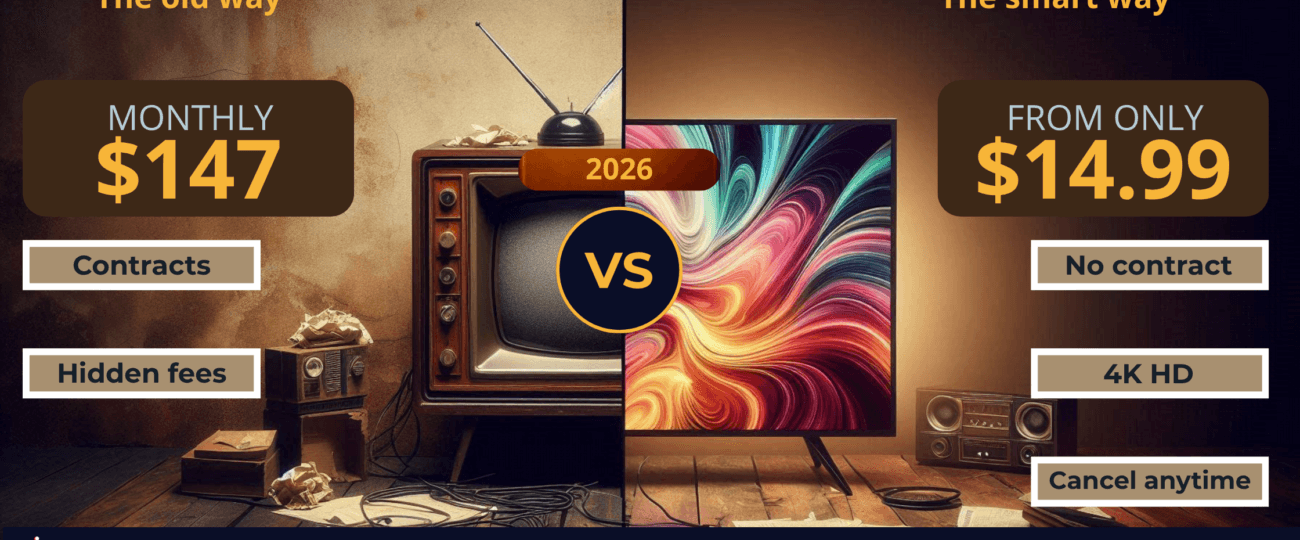
The average American cable household now pays $147 per month when all fees are included. That’s $1,764 per year — and the channel lineup keeps shrinking.
Here’s what most articles won’t tell you: stacking too many streaming services can cost as much as cable. The average U.S. household subscribing to 4–5 platforms now pays around $69–$80/month — basically what cable used to cost a decade ago.
The winning strategy in 2026 is not stacking — it’s choosing one premium streaming subscription that covers everything you actually watch.
A well-chosen premium streaming subscription can give you:
That’s a potential savings of over $1,200 per year compared to traditional cable.
Traditional cable offers 100–500 channels — but here’s the truth most subscribers eventually realize: the average household actively watches fewer than 17 of them. You’re paying for hundreds of channels you’ll never turn on.
Premium streaming platforms deliver:
For families abroad — particularly the Maghrebi and African diaspora across Europe — streaming has become the only realistic way to stay connected with content from back home while also enjoying global entertainment.
This is where the streaming vs cable TV debate becomes one-sided.
| Feature | Cable TV | Premium Streaming |
|---|---|---|
| Watch anywhere | ❌ Tied to your home | ✅ Phone, tablet, TV, laptop |
| Cancel anytime | ❌ Often locked into contracts | ✅ Month-to-month freedom |
| Set-up | ⚠️ Technician installation needed | ✅ Activated in minutes |
| Travel-friendly | ❌ Stops at your front door | ✅ Watch abroad with your subscription |
| Multi-user access | ⚠️ Limited to one TV | ✅ Multiple connections supported |
| 4K picture quality | ⚠️ Premium fee required | ✅ Often included |
A premium streaming subscription like DIGIWIDE TV lets you take your entertainment everywhere — your living room, your bedroom, your morning commute, your trip back home. With cable, the moment you leave the couch, the experience ends.
In 2026, anything less than 4K HD is starting to feel outdated — and for good reason. Modern TVs are designed for 4K content, with vibrant colors, sharper details, and smoother motion than cable broadcasts can deliver.
Most cable providers still distribute the majority of their channels in standard or 1080p resolution, with 4K reserved for premium add-ons (and even then, only for selected events).
Premium streaming services now offer 4K HD as the baseline — not as an upsell. If you’ve invested in a quality smart TV, sticking with cable means you’re literally not seeing what your screen can show you.
This is the only area where cable still has a real argument — but the gap is closing every year.
In 2026:
For most viewers, the content variety, on-demand convenience, and savings of streaming far outweigh the narrow advantage cable holds for niche live sports broadcasts.
If you live in France, Belgium, the Netherlands, Germany, Spain, or Italy and you’re part of the Maghrebi or African diaspora, the switch to streaming is even more urgent.
Why?
For families separated by borders, premium streaming isn’t just an entertainment choice — it’s a way to stay culturally connected.
Here’s the honest summary:
For the vast majority of modern households — and especially for the diaspora across Europe — streaming is no longer the alternative. It’s the smart default.
At DIGIWIDETV, we built a premium streaming service designed for the modern viewer:
Whether you’re a single user or a family, our plans start at just $14.99/month — less than 20% of what most European households pay for cable.
🎁 Try DIGIWIDE TV Risk-Free Start with our 72-hour trial for $5.99 and experience premium streaming yourself. No commitment, no surprises. 👉 Start Your Free Trial
Yes — when chosen wisely. A single premium streaming subscription typically costs $7–$15/month, while the average cable bill exceeds $80/month in the U.S. and €40–€60/month in Europe. The trick is to avoid stacking too many separate platforms and instead choose one comprehensive premium streaming service.
For 4K HD streaming, a stable connection of 25 Mbps or higher is recommended. Most modern home internet plans in Europe and North America easily meet this requirement.
Absolutely. Premium streaming services like DIGIWIDE TV are compatible with smart TVs, Android boxes, smartphones, tablets, and computers through dedicated player applications.
No. Unlike cable, premium streaming subscriptions like DIGIWIDE TV operate on a flexible month-to-month basis — you can upgrade, downgrade, or cancel anytime.
That’s exactly why DIGIWIDE TV offers a 72-hour trial subscription. You test the service first, and only commit if you’re satisfied.
The data is clear, the math is undeniable, and the experience speaks for itself. Streaming has won the war against cable TV in 2026 — not because cable disappeared, but because viewers finally have a better, cheaper, and more flexible alternative.
If you’re still paying $80, $100, or even $150 every month for cable, ask yourself one question: What are you actually getting for that money?
Then take 72 hours to discover what premium streaming feels like.
👉 Start Your DIGIWIDE TV Free Trial Now
Cut the cable. Keep the quality.
About DIGIWIDE TV

DIGIWIDE TV is a premium streaming subscription service offering 4K HD content, multi-device access, and flexible plans for households worldwide. Learn more at www.digiwidetv.com.